
Performance-Based NRW Projects
Asbestos cement pipe remains a significant legacy asset across many Australian water networks. For utilities and councils managing ageing infrastructure, the challenge is rarely just identifying where AC mains exist. The bigger issue is understanding which parts of the network are still performing reliably, which are becoming higher risk, and how to prioritise action before failures, service disruption, and reactive costs start to escalate.
That is why asbestos cement pipe assessment matters. A network with ageing AC mains does not need blanket assumptions or a one-size-fits-all renewal response. It needs a clearer view of the condition, likely remaining life, the consequences of failure, and where limited capital will have the greatest impact. Australian sector guidance reflects this shift, with AC pipe management framed around deterioration, renewal, and better condition information rather than broad age-based assumptions alone.
In this article, we’ll look at what asbestos cement pipe is, why ageing AC networks create growing asset management challenges, how utilities assess AC pipe condition more effectively, and how that supports smarter renewal and risk planning across the network.
Asbestos cement pipe, often shortened to AC pipe, is a cement-based pipe material reinforced with asbestos fibres. It was widely used in water networks for decades because it was practical, cost-effective, and well-suited to the needs of buried water infrastructure at the time. As a result, many Australian utilities and councils still manage substantial lengths of AC mains today.
That legacy matters because asbestos cement pipe is no longer just a material record in the asset register. In many networks, it now represents a large ageing cohort that needs closer attention. Some sections may still be performing adequately, while others may be approaching a point where deterioration, break history, operating conditions, and consequences of failure become more important than age alone.
This is why AC pipe remains such a relevant topic in Australian water network management. The issue is not simply whether asbestos cement pipe is present in the ground. The real question is how utilities assess their condition, estimate likely remaining life, and decide where to monitor, rehabilitate, or renew first. For asset managers and network operators, that makes AC pipe assessment a planning and prioritisation issue as much as a material one.
Ageing asbestos cement pipe becomes harder to manage because performance tends to become less predictable over time. While AC mains were widely installed across Australian networks and many have delivered long service lives, not every pipe cohort ages in the same way. Two sections of similar age can present very different levels of risk depending on how and where they have operated.
That is one reason age alone is not enough when assessing AC pipe. Utilities also need to consider the broader conditions shaping deterioration and failure risk, including:
There is no single life expectancy for asbestos cement pipe. Some AC mains remain in service for many decades, while others deteriorate sooner due to the conditions they operate in and the way they have aged over time. For utilities, that is why this question needs a more careful answer than a fixed number.
In practice, asbestos cement pipe life expectancy depends on a mix of factors, including pipe cohort, age, wall thickness, pressure class, water chemistry, soil conditions, operating pressures, and historical failure patterns. Two AC mains installed in a similar period can still perform very differently if one has been exposed to harsher operating or environmental conditions than the other.
For most utilities, replacing every asbestos cement main at once is neither practical nor cost-effective. At the same time, deferring action across the board can create a different problem: rising break rates, more reactive maintenance, and less confidence in where future capital should be directed. That is why AC pipe condition assessment matters. It helps utilities move beyond broad assumptions and make more targeted decisions about where risk is actually emerging across the network.
This is especially important with ageing AC networks because not all assets of the same age or material present the same level of urgency. A condition-led approach helps separate lower-risk sections that may remain serviceable from segments that are more likely to create operational, financial, or service impacts in the near term. Rather than treating the network as one uniform AC cohort, utilities can build a clearer picture of where attention is most justified.
That clarity supports better planning outcomes. Pipeline condition assessments can help improve renewal timing, strengthen capital prioritisation, reduce avoidable reactive costs, and support more defensible business cases for intervention. In practical terms, it gives utilities a stronger basis for deciding where to monitor, where to investigate further, and where renewal or rehabilitation may deliver the greatest value.
Assessing an ageing asbestos cement network usually starts with building a clearer picture of which AC assets are most likely to create future risk. The goal is not to inspect every pipe section in isolation. It is to combine available asset, performance, and network data in a way that helps utilities prioritise attention where it is likely to matter most.
A typical assessment process includes a few core steps:
Once an ageing AC network has been assessed, the next step is deciding what response makes the most sense for each part of the system. That decision is rarely as simple as replacing every section of asbestos cement pipe on the same timeline. In most networks, the better approach is to match the response to the level of condition, risk, criticality, and likely remaining life across each cohort or segment.
The three most common response pathways are:
Good asbestos cement pipe assessment should lead to more confident decisions, not just more data. When utilities understand which AC assets are deteriorating, which remain serviceable, and which carry the highest consequence of failure, they can make smarter choices about where to act first.
When utilities manage ageing asbestos cement networks without a structured assessment process, a few common planning mistakes tend to appear:
Avoiding these mistakes helps utilities focus effort where it is most likely to reduce risk, improve service continuity, and support more confident renewal planning.
Managing an ageing asbestos cement network is not just about knowing where AC pipe exists. The bigger challenge is knowing which sections are still performing reliably, which are beginning to deteriorate, and which are most likely to create future cost, disruption, or risk if left too long.
That is where we help bridge the gap.
At Aqua Analytics, we help utilities turn AC pipe assessment into practical planning insight. Not just more data, and not just another report. We help build a clearer view of pipe condition, likely deterioration, and renewal priority so there is a stronger basis for deciding what to monitor, what to rehabilitate, and what to replace.
That shift matters. When you have a clearer picture of which AC water mains are moving closer to higher risk, planning becomes more targeted. Capital can be allocated with more confidence. Renewal decisions become easier to justify. Operations teams can focus attention where it will have the greatest impact, rather than waiting for failures to force action.
For many utilities, that is the real value of a smarter assessment approach. It is not simply identifying ageing AC assets. It is using that insight to support better timing, better prioritisation, and more confident network decisions.
If your network includes ageing asbestos cement mains, we can help you build a clearer understanding of what is happening across those assets and where attention is likely to be needed first.
We work with utilities to move beyond broad assumptions and make more informed decisions about ageing pipelines. That may mean assessing critical sections of AC main, supporting longer-term planning across larger cohorts, or helping your team better understand where repair, rehabilitation, or renewal is likely to deliver the most value.
The goal is simple: give you better evidence for the decisions that matter, so AC pipe assessment leads to action rather than uncertainty.
If you need a clearer view of AC pipe condition, likely remaining life, or renewal priority across your network, get in touch with us today to discuss the next step.
Sewer rising mains, or force mains as they are known in some countries, are critical to wastewater management in Australia and New Zealand. These pressurised pipelines pump sewage from lower to higher elevations, often over considerable distances and under complex environmental conditions. However, given the constant operational demands on these pipelines, sewer rising mains are vulnerable to various forms of deterioration and failure. A strategic assessment approach is essential to mitigate risks, maintain functionality, and uphold public health and environmental standards.
This article delves into the mechanisms behind sewer rising main deterioration, the importance of targeted assessments, and the range of modern solutions available to extend the service life of these critical assets.
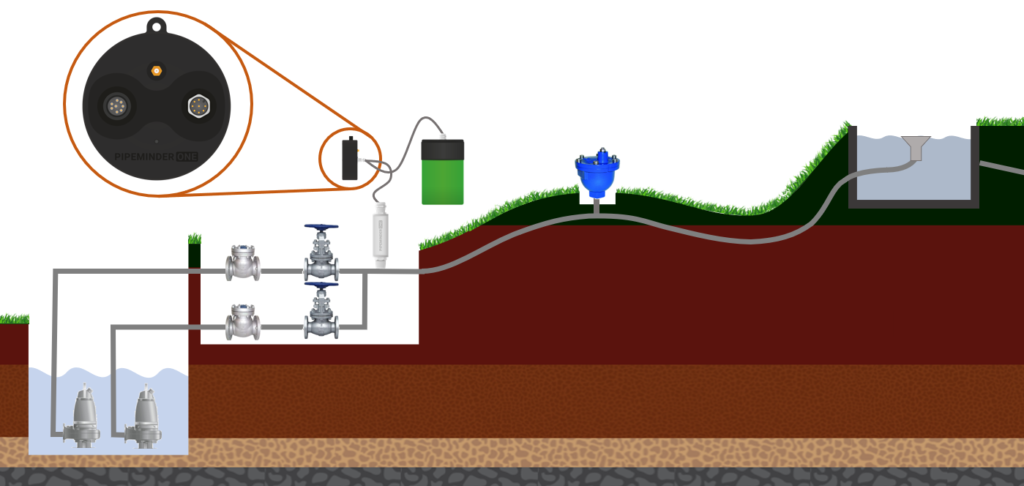
Sewer rising mains are subjected to rigorous physical and chemical challenges. These challenges, if not adequately managed, can significantly accelerate the pipeline’s degradation. Key failure mechanisms include:
Fatigue and Mechanical Stress
Rising mains operate under constant pressure due to their role in pushing wastewater against gravity. Pump regimes, specifically cyclic loading and pressure transients, place recurring stresses on the pipeline material. Over time, this leads to fatigue, weakening the pipeline structure and increasing its susceptibility to cracks and bursts.
Hydrogen Sulphide (H₂S) Corrosion
One of the most insidious threats to sewer rising mains is hydrogen sulphide (H₂S) gas, which is prevalent in sewer environments. H₂S can accumulate in gas pockets along the pipeline. When mixed with moisture, it forms sulfuric acid, which corrodes the pipeline walls. This is particularly problematic in areas with inadequate venting or where air valves are absent (or closed to avoid public odour complaints).
Transient Pressure Surges
Pressure transients, or “water hammer” events, are common in sewer rising mains due to sudden pump starts and stops. These surges produce high-pressure shockwaves that stress the pipeline, exacerbating fatigue and leading to crack formation or even catastrophic failure.
Given these unique challenges, the implementation of smart monitoring and regular assessments of sewer rising mains are paramount to ensure system integrity and avoid costly, large-scale repairs or environmental hazards.
Rising main failures can lead to uncontained sewage leaks, contaminating waterways and posing a public health risk. Identifying weak points in the system prevents such incidents, protecting the community from exposure to untreated sewage.
Sewer rising mains are often situated near ecologically sensitive areas. A failure can lead to sewage spills, severely impacting local ecosystems and water quality. By maintaining the integrity of these mains, utilities can avoid such environmental repercussions and additional financial penalties from the regional Environmental Protection Agency (EPA).
As core infrastructure serving vast numbers of the population, sewer rising mains require a strategic approach to maintenance. Ongoing monitoring and routine condition assessments allow utilities to forecast replacement needs, prioritise maintenance, and optimise resources. This approach is crucial for extending the asset’s lifecycle and controlling long-term operational costs, all while managing failure risk.
Several modern technologies and methodologies can be employed to detect and address issues before they escalate. Key approaches include:
Pressure Transient Monitoring
Given the damage that pressure transients can cause, monitoring for these events is essential. Installing transient pressure monitoring devices provides valuable data on the frequency, duration, and magnitude of pressure spikes. This data allows engineers to adjust pump schedules and implement additional surge protection measures where needed.
Gas Pocket Detection
Hydrogen sulphide-related corrosion is one of the primary causes of sewer rising main deterioration. Detecting and locating H₂S gas pockets along the pipeline is critical for targeted maintenance. Once detected, these pockets often indicate locations where air valves are needed, helping to mitigate future gas accumulation and the resulting corrosive environment.
In-line Screening Tools
Tools like AquaSphere provide a reliable in-line screening solution for sewer rising mains. This free-swimming device navigates the pipeline and identifies existing leaks, potential weak points and gas pockets. By pinpointing areas of concern, AquaSphere enables utilities to target on-pipe testing locations more effectively, reducing the need for invasive testing across the entire pipeline. This focused approach is particularly useful for directing ultrasonic or similar wall thickness measurement technologies to areas at high risk of failure.
Ultrasonic Wall Thickness Testing
For a more detailed analysis, ultrasonic testing can assess pipe wall thickness and detect internal and external corrosion signs. By focusing ultrasonic testing on areas identified through in-line screening, utilities can limit the invasive procedures and associated costs, such as traffic control, to sections at higher risk, maximising the value of screening and detailed assessments.
Sewer rising main assessments are most effective when the approach is precise and targeted. By leveraging a combination of in-line screening, transient monitoring, and gas pocket detection, utilities can:
Reduce the Risk of Unplanned Failures
Proactive identification and mitigation of potential failure points help prevent unexpected service interruptions, ensuring that utility operations remain smooth and uninterrupted.
Extend the Asset’s Lifespan
Regular assessments and targeted maintenance enable utilities to extend the useful life of sewer rising mains. A targeted approach minimises wear and tear on newer segments, focusing resources where they are most needed.
Optimise Maintenance Budgets
Rising main assessment strategies enable more efficient use of maintenance budgets. Utilities can allocate resources more effectively by pinpointing areas of concern and avoid the high costs associated with emergency repairs and unplanned downtime.
For water utilities in Australia and New Zealand, sewer rising main condition assessments are essential for safeguarding public health, protecting the environment, and maintaining operational efficiency. By addressing deterioration factors like hydrogen sulphide corrosion, pressure surges, and mechanical fatigue through targeted assessments, utilities can ensure the longevity and reliability of these critical assets.
In-line screening tools like AquaSphere and pressure transient monitoring, as well as ultrasonic testing offer an optimised approach to sewer rising main assessment. Such a strategy not only prolongs the asset’s life but also enhances the cost-effectiveness of maintenance operations, allowing for sustainable infrastructure management.
Whether for metropolitan utilities or regional authorities, adopting a proactive assessment methodology for sewer rising mains can transform reactive maintenance into strategic asset management, ensuring these essential pipelines continue to serve communities for decades to come.
For more information, or to submit a project scope for review, please contact us today.