Accurate & Non-Destructive Pipe Condition Assessment
Aqua Analytics delivers high-quality pipeline condition assessments using advanced, non-invasive technologies that provide accurate data on the true condition of buried water and wastewater mains. Our approach equips asset owners with the confidence to prioritise repairs, schedule renewals, and defer capital works where appropriate, ensuring smarter and more cost-effective asset management decisions.
By combining free-swimming leak and gas pocket detection, high-resolution wall thickness profiling, transient pressure monitoring, and targeted on-wall inspections, we provide defensible, engineering-grade insights without the need for destructive excavation. This helps extend the remaining useful life of critical pipelines.
Contact our team to arrange a pipeline condition assessment across Australia or New Zealand.
Call 1800 264 262 (Australia) or 0800 345 697 (New Zealand).
Australia’s Leaders in Water Pipe Condition Assessment
Some of the reasons Aqua Analytics is the trusted pipeline condition assessment services provider include:
- Aqua Analytics has years of experience in water distribution and pipeline inspection and assessment, ensuring that we provide expert and reliable services personalised to your needs.
- Our team of highly trained and skilled technicians uses the latest technology and methodologies to deliver accurate and detailed assessments of your pipeline infrastructure.
- We employ advanced, non-invasive, and non-destructive technologies to assess pipeline conditions, ensuring precise data collection without the need for disruptive excavations.
- We have a proven history of delivering successful pipeline condition assessment projects, providing clients with actionable insights that lead to better asset management and cost savings.
- We offer customised solutions that meet the specific needs of each utility, providing detailed reports and recommendations for repair, replacement, and maintenance strategies that enhance the reliability and longevity of your water distribution network.
Understanding Pipeline Condition Assessment
Dynamic Response Imaging™ (DRI™), engineered by KenWave Solutions, serves as a pivotal tool for Pipeline Condition Assessment in Australia.
Specialising in the identification of distressed pipe sections, DRI™ employs non-intrusive and non-invasive techniques to obtain comprehensive pipe condition information. Notably, KenWave’s state-of-the-art equipment operates without necessitating entry into the water column, thereby ensuring uninterrupted water service—unlike traditional inline pipe technologies, and doesn’t require pipeline shutdowns that can be disruptive to utility operations.
Adaptable across various pipe materials, sizes, and diameters, DRI™ is suitable for both transmission and distribution pipelines within public, private, and industrial water networks.
Our advanced technology provides high-resolution pipeline conditions and leak data equivalent to or better than individual pipe segments.
The gathered data serves as an invaluable resource for asset owners, operators, and managers in the domain of Pipeline Asset Management. It facilitates a precise understanding of the Remaining Useful Life of critical pipeline assets. It enables informed decision-making in operations management, risk assessment, and budget planning for replacement and rehabilitation initiatives.
Pipe Materials for Pipe Condition Assessment:
- Cast Iron (CI)
- Cast Iron Cement Lined (CICL)
- Ductile Iron Cement Lined (DICL)
- Asbestos Cement (AC)
- PVC
- PE
Aqua Analytics provides both one-off pipeline condition assessments for critical water mains and structured, long-term inspection programs to support strategic asset planning.
Our engineers and technicians identify defects, gas pockets, wall loss, and operational risks, delivering clear, evidence-based recommendations for repair, rehabilitation, or renewal.
Whether you require a targeted investigation or an ongoing assessment program, our methodology helps utilities and councils reduce failure risk, optimise capital investment, and extend the life of ageing water and wastewater pipelines.
Our pipeline inspection and assessment services are trusted by utilities and consultants across the region.
Case Study: Safeguarding a Critical Trunk Main at a Major Transport Hub
How Aqua Analytics assessed pipeline condition and informed long-term planning
A major Queensland transport hub identified a single trunk water main as a critical point of failure, with the potential to disrupt operations supporting 28 million tonnes of cargo annually. The client required clear, defensible insight into the condition and remaining life of the asset to manage risk and inform long-term planning.
We delivered a non-invasive pipeline condition assessment using advanced vibroacoustic DRI technology, completing the work over three nights without disrupting operations.
Detailed analysis confirmed the main’s condition and projected a remaining useful life of approximately 40 years, giving the client confidence to defer replacement, prioritise maintenance, and protect a vital piece of infrastructure.
Understanding the Benefits of Pipeline Condition Assessment

Accurate Data for Smarter Asset Management
Pipe condition assessment provides precise and detailed information about the state of your buried pipes. This accurate data allows you to make informed decisions about maintenance, repairs, and replacements, ensuring that your resources are used effectively.
Identification of Pipes in Good Condition vs. Those Needing Repair or Replacement
Our services help you identify which parts of your infrastructure are still in good condition and which require attention by assessing the condition of each pipeline. This targeted approach helps prioritise repairs and replacements, preventing unnecessary work and focusing efforts where they are most needed.
Cost Savings Through Targeted Repairs and Maintenance
Using accurate data to guide your maintenance and repair efforts can lead to significant cost savings. By focusing on the areas that need attention and avoiding unnecessary work, you can reduce operational expenses and extend the lifespan of your infrastructure.
Extension of Asset Lifespan Through Pressure Management
Our pipeline condition assessment can also help determine whether pressure management strategies can be used to extend the life of your assets. By optimising pressure within the system, you can reduce stress on the pipes, minimise the risk of leaks and bursts, and enhance the overall durability of your water distribution network.
Why are the legacy approaches of condition assessment outdated?
Too often, utility companies spend money replacing ageing water or wastewater pipelines based on inadequate pipeline conditions or leak detection data. This data may include soil corrosivity, spot checks on wall thickness at convenient locations or desktop assessments that don’t consider any ‘ground truth’ information.
Other water utilities adopt reactive approaches to bursts (or pipeline age) rather than undertaking technology-driven pipeline assessment activities to prevent them. Despite increased spending on pipeline testing and real-time pipeline monitoring, the information gap around buried pipeline conditions still exists, even though non-invasive, non-disruptive technologies are available. These technologies allow technicians to collect higher-quality data for asset management decision-making. Using these advanced data collection technologies and their associated data analysis, Aqua Analytics brings pipe condition assessment into the 21st century and allows utilities to be more resilient, proactive and comprehensively managed.
If you are looking for Pipeline Inspection and Assessment in Australia or New Zealand, contact us today.
What technology is used for pipeline condition assessment?
Aqua Analytics uses non-invasive, non-disruptive Dynamic Response Imaging™ (DRI) from Kenwave Solutions to conduct water pipeline condition assessments.
This vibroacoustic pipeline assessment technology is designed for use on in-service pipes of all standard materials and diameters. Aside from using DRI, it will provide detailed, reliable condition assessment and leakage information along the asset’s length using acoustic principles.
Our pipeline assessment technologies operate without disruption to your regular network operations and pose no risk of damage to the asset.
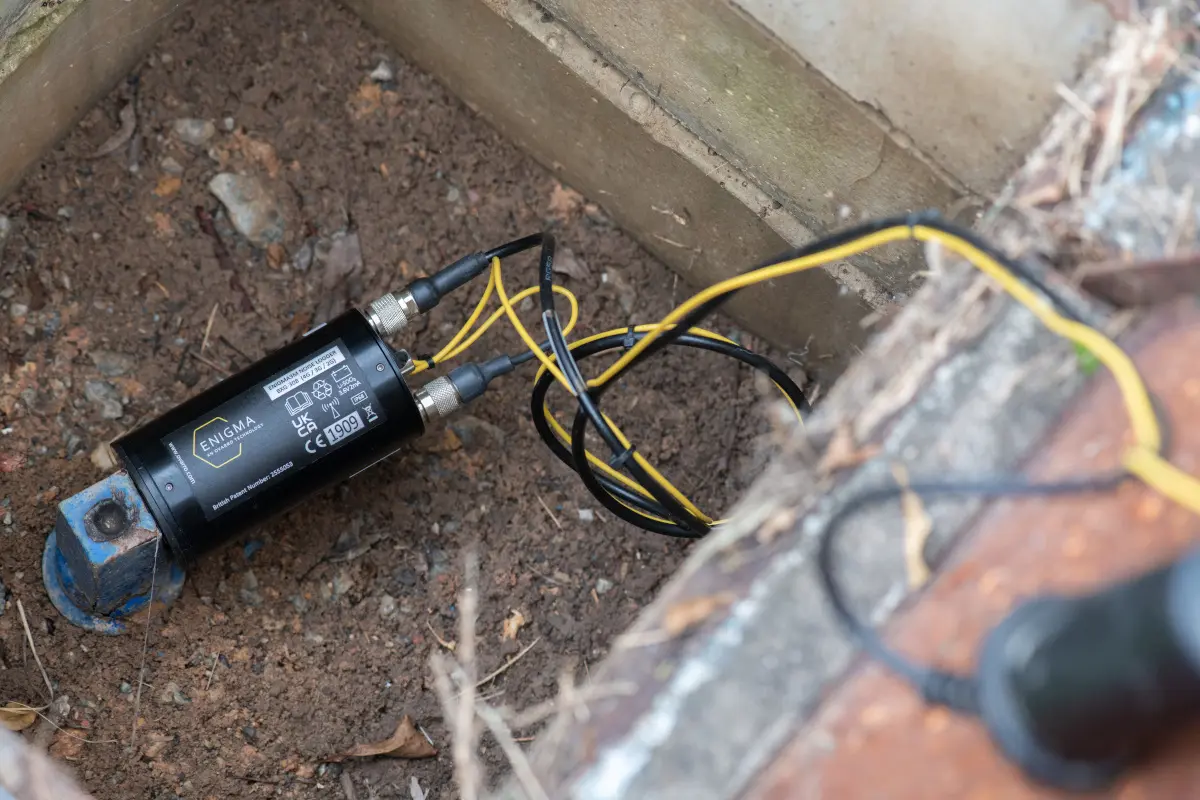
The device is installed on the pipeline during normal operating conditions, and expert engineers collect data measurements for analysis. Above-ground connections to fittings and appurtenances are satisfactory.
Kenwave’s DRI represents the next evolution of leak noise correlators, with improved sensor sensitivity and the ability to collect multiple data types simultaneously. Its focus is on safety and ease of use.
What is the process for undertaking a condition assessment?
Firstly, we develop a multi-parameter vibroacoustic model specific to the pipe we are inspecting. Test signals are then computed and introduced via the DRI vibration source before they are measured downstream by the DRI sensors.
We then compare the models with the measurements and deduce wall properties and anomaly locations. The results are then validated, and the DRI database and modelling algorithms are updated to improve the accuracy of subsequent inspections. This improved accuracy has immense benefits when conducting water pipeline condition assessments. We can track this data over time and determine the best possible solutions for the water pipe network.
Aside from using Dynamic Response Imaging, during most pipeline condition assessment projects, we also simultaneously collect pressure transient data using the Syrinix RADAR solution, and can also couple DRI results by undertaking on-pipe wall thickness measurements using the Acquaint PipeScanner technology.
Overall, our approach to pipeline inspection and assessment is comprehensive, combining advanced diagnostics, high-quality field data, and experienced engineering review to deliver clear, defensible insights on asset condition and remaining useful life. By integrating technologies such as free-swimming leak and gas pocket detection, high-resolution pipe wall thickness measurement, transient pressure monitoring, and desktop risk modelling, we help asset owners confidently prioritise renewals, reduce failure risk, and extend the life of critical water and wastewater mains. This end-to-end methodology ensures reliable decision-making, optimised capital investment, and improved network performance across Australia and New Zealand.
What materials and diameters can the technology be applied to?
Our noninvasive DRI technology can be used to inspect pipes that transfer water. It is also designed to study nonmetallic and plastic pipes (including Asbestos Cement, PVC, MDPE, HDPE, and GRP).
In addition to the above, we can utilise DRI technology for large-scale asbestos cement assessment projects when a water utility has a large proportion of AC mains and needs to prioritise its renewals and investments. Many cities and towns in Australia and New Zealand face a problem with their ageing asbestos cement and metallic pipelines, with billions of dollars in renewals required over the next five decades.
Aqua Analytics can also inspect mixed material pipes, such as when a small section has been repaired with ductile iron or PVC.