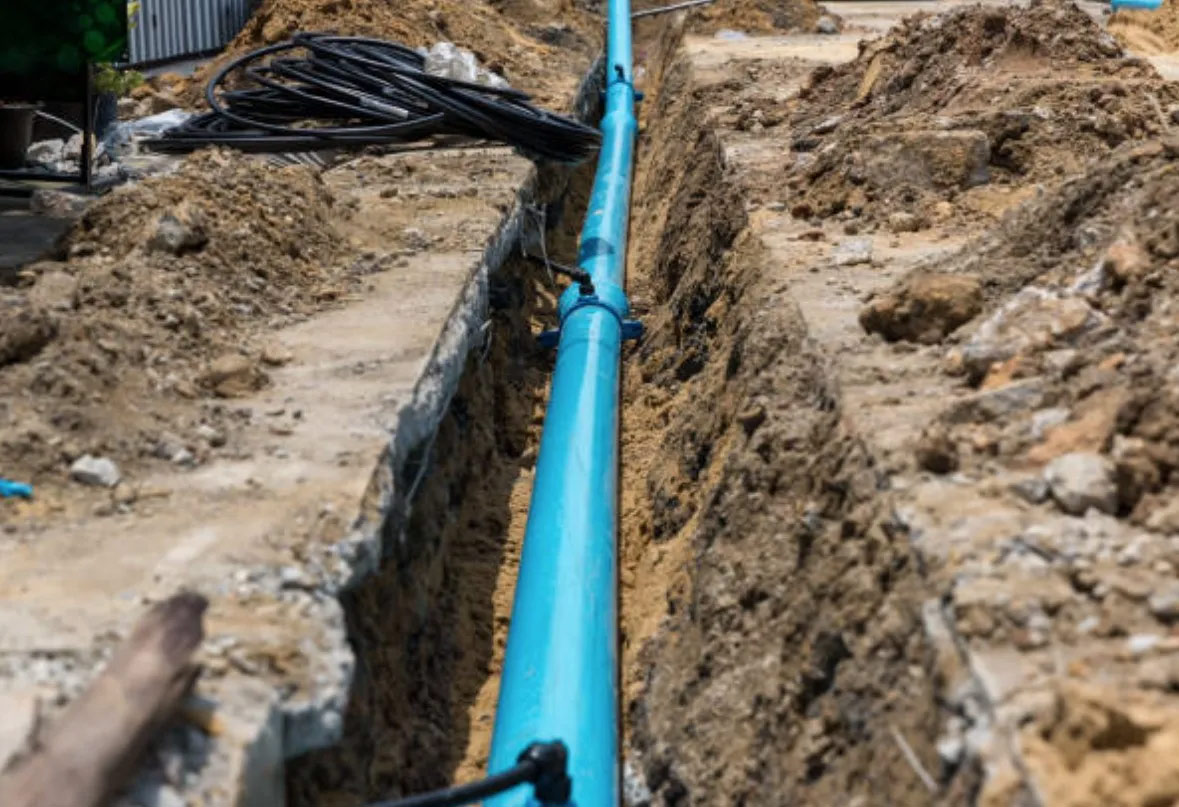
The renewal decision every utility is getting half right
Ask most asset managers which water mains they plan to replace next year and the answer rests on three things: pipe age, pipe material and break history. Those are reasonable proxies. They are also the reason so much serviceable pipe is dug up early while the main that actually bursts was never on the list.
Pipes of the same age, material and soil deteriorate at very different rates. A 1960s cast iron main under a quiet cul-de-sac can have 90% of its wall left; the same spec main two streets over, under a bus route with a stray-current problem, might be a shell. Without condition data, the renewal programme cannot tell them apart.
Non-invasive pipe condition assessment closes that gap. ePulse, the acoustic condition assessment method developed by Echologics (a Mueller Water Products brand), measures the actual remaining wall thickness of a buried main from the surface, in service, without excavation and without interrupting supply. Aqua Analytics delivers ePulse across Australia and New Zealand as part of our pipeline condition assessment services.
This article explains how the method works, what it does and does not tell you, how it compares with the alternatives, and where it earns its keep in an ANZ renewal programme.
How ePulse measures pipe wall thickness without digging
ePulse works on a simple piece of physics: the speed at which a low-frequency sound wave travels along a water-filled pipe depends on the stiffness of the pipe wall. A pipe that has lost wall thickness to corrosion or leaching is less stiff, so sound travels through it more slowly. Measure the speed, and you can back out the average remaining wall thickness.
In the field, the process looks like this:
- Two sensors are attached to existing fittings. Hydrants, valves or meter chambers, typically 100 to 200 m apart on distribution mains, further on trunk mains. Nothing is cut, tapped or excavated. The main stays in service at normal pressure.
- A sound wave is induced in the pipe. Usually by opening a hydrant or using a small surface source. The wave travels along the pipe between the two sensors.
- The arrival time at each sensor is recorded to high precision, and the distance between the sensors is measured accurately on site.
- The propagation velocity is calculated and compared against the theoretical velocity for that pipe’s diameter, material and original wall thickness.
- The difference is converted into an average remaining wall thickness for the segment, expressed as a percentage of the original and graded good, moderate or poor.
Because the sensors are already listening to the pipe, the same deployment also picks up leak noise. Any leak within the test segment is flagged and correlated as part of the survey, so a condition assessment programme doubles as a trunk main leak detection sweep at no extra mobilisation.
The acoustic approach is closely related to the acoustic leak detection correlation our crews use every night. The difference is what we do with the arrival times: a correlator uses them to find where a noise is coming from; ePulse uses them to measure how fast sound is travelling, and therefore how much pipe is left.
What ePulse tells you, and what it doesn't
ePulse is a screening tool for pressurised mains, and it is at its best when you treat it as one. Being clear about its outputs up front avoids the two common mistakes: expecting it to find a single pit, or dismissing it because it won’t.
What you get for each segment
- Average remaining structural wall thickness, as a percentage of the original design thickness
- A condition grade (good, moderate, poor) with an indicative remaining service life estimate, based on wall loss and assumed deterioration rate
- Any leaks detected within the segment, located by correlation
- A GIS-ready results layer that drops straight into the renewal model
Pipe materials it works on
ePulse was built for metallic mains (cast iron, ductile iron, steel) and has since been validated on asbestos cement and concrete pressure pipe, which is where much of the ANZ demand sits. On AC, the method is particularly useful because the deterioration mechanism, lime leaching that softens the wall from the inside and outside, is exactly the kind of uniform stiffness loss the acoustic velocity picks up well. Our guide to asbestos cement pipe assessment covers the AC problem in more depth.
Plastic pipe (PVC, PE) is not a candidate. Those materials do not corrode or leach, and their acoustic behaviour is dominated by the material rather than the wall thickness.
Limits to keep in mind
- It is an average, not a map. ePulse reports the mean wall thickness across the segment between sensors. It will show that a 150 m run has lost 35% of its wall. It will not tell you that 140 m is fine and 10 m is about to fail. That is what shorter sensor spacing, or a follow-up inline inspection or NDT at an excavation, is for.
- It needs good as-built data. Diameter, material, original wall class and accurate fitting positions all feed the calculation. Where the GIS is wrong, the result is wrong. A good contractor verifies these in the field rather than taking the model on trust.
- It needs clean acoustics. Heavy traffic, pump stations, air pockets and partially closed valves inside the test segment all degrade the signal. Night work and a bit of valve operation are often part of the method.
- Lined pipe reads differently. Cement mortar lining adds stiffness that is not structural. The analysis accounts for it, but the as-built record has to say the lining is there.
None of this makes ePulse less useful. It makes it a tool for ranking hundreds of segments by likely condition at a cost per kilometre that no excavation-based method can approach, so the expensive, precise methods get pointed at the right 5% of the network.
ePulse compared with other condition assessment methods
No single method covers every pipe or every question. The table below sets ePulse against the approaches utilities most often weigh it up against. Cost and coverage are indicative relative rankings, not quotes.
| Method | What it measures | Invasive? | Shutdown? | Coverage per day | Relative cost | Best used for |
|---|---|---|---|---|---|---|
| Desktop modelling (age, material, breaks) | Probability of failure | No | No | Whole network | Lowest | First-pass prioritisation; no actual condition data |
| ePulse acoustic assessment | Average remaining wall thickness per segment; leaks | No | No | Several km | Low | Screening metallic, AC and concrete mains to rank renewals |
| Inline acoustic / electromagnetic inspection (tethered or free-swimming) | Localised wall loss, leaks, gas pockets, in some tools joint and liner condition | Yes (single insertion) | No | 1–10 km | Medium–high | Critical trunk mains where localised defects matter |
| Electromagnetic / magnetic flux (external or inline) | Localised metal loss and wire breaks | Partly | Often | Hundreds of metres | High | PCCP and ferrous trunk mains with known risk |
| Pit excavation with NDT (ultrasonic, phenolphthalein for AC) | Precise wall thickness at one spot | Yes | Sometimes | A handful of spots | High per point | Calibrating screening results; confirming a renewal decision |
| Coupon sampling | Lab-tested remaining strength | Yes | Yes | One sample | High per point | Forensic analysis after failures |
The pattern is clear once it is laid out. Desktop models are cheap but blind. Excavation and inline tools are precise but expensive and slow. ePulse sits in the middle: real measured condition, at network scale, for a fraction of the cost of the precise methods. The most effective programmes we run use it as the screen, then spend the precise-method budget only where ePulse says the problem is.
For trunk mains, where a single failure can close a highway or drop supply to a town, we usually recommend both: an ePulse screen across the whole length, followed by inline inspection of the segments that grade moderate or poor.
What an ePulse programme looks like in practice
A well-run ePulse programme is mostly planning. The field work is quick; the value comes from choosing the right segments and getting the results into the renewal model in a form the asset team will actually use.
1. Scoping (two to four weeks)
We start with the utility’s GIS and renewal shortlist. Segments are selected by consequence of failure as much as likelihood: the main under the main street matters more than the one in the paddock. We check pipe records, fitting spacing and access, and flag anything the GIS looks unsure about. Typical scopes run from 20 km on a single-town council to several hundred kilometres across a metropolitan utility.
2. Field deployment (days to weeks, depending on length)
A two-person crew works fitting to fitting, attaching sensors, inducing the signal and recording. A distribution crew covers several kilometres per shift in good conditions. There is no excavation, no traffic management beyond the usual for working at a hydrant, and customers see nothing. Where background noise is a problem, night shifts solve most of it.
3. Analysis and quality control
Each segment’s velocity is processed against its pipe parameters, and the analysis is reviewed before a grade is assigned. Where a result looks inconsistent with neighbouring segments or with the pipe record, the crew re-tests or confirms the as-built on site. On most programmes we recommend a small number of calibration pits, excavated at segments spanning the condition range, so the acoustic results are tied to measured wall thickness on that network.
4. Reporting
Deliverables are a segment-by-segment condition register, a GIS layer graded good/moderate/poor, a leak register for anything found along the way, and a short written assessment of what the results mean for the renewal programme. The register is built to feed straight into predictive asset management modelling, so the condition data changes the capital plan rather than sitting in a PDF.
5. Re-test cycle
For segments in good condition, industry practice is to re-test in five to ten years depending on consequence of failure, which turns a one-off survey into a deterioration rate. Two data points a few years apart are worth far more than one.
Where ePulse pays back for Australian and New Zealand utilities
The economics are not subtle. Replacing a kilometre of distribution main in an Australian or New Zealand town costs in the high hundreds of thousands of dollars and often more under a sealed road. Assessing that kilometre acoustically costs a small fraction of that. Echologics reports that utilities running ePulse programmes have deferred 30–60% of planned replacement after the data showed pipes were in better shape than their age suggested, and that the assessment typically runs at under 5% of replacement cost. Those are the vendor’s figures, but they are consistent with what we see on the ground.
Four situations where the case is strongest:
Asbestos cement networks nearing nominal end of life. AC is the single largest condition-assessment question in ANZ. Much of it was laid between 1950 and 1980, and age-based models have it all falling due at once. ePulse lets a council rank its AC mains by actual wall loss and spread renewals over a realistic horizon. Our Western Australia AC condition assessment case study shows this working on a regional network.
Cast iron and early ductile iron in older suburbs. Metallic mains that have been in the ground 60–100 years are the first place to look for stray-current and soil-driven corrosion. An ePulse screen separates the mains that are still sound from the ones driving the burst history.
Renewal programmes that need to be defended. Regulators, boards and councillors are increasingly asking for evidence behind capital plans. A measured condition grade is a far easier conversation than “it is 70 years old”. Our article on planning pipeline renewal with data-backed insights goes into how utilities are using that evidence.
Trunk mains between full inspections. Inline inspection of a critical trunk main is a major exercise. An ePulse screen in the years between gives early warning if a segment is deteriorating faster than expected, without a shutdown or an insertion.
The common thread is that ePulse turns an assumption into a measurement at a cost that lets you measure the whole problem, not a sample of it. For a broader view of how condition data fits into asset planning, see our guide to water infrastructure assessments and the current state of Australia’s ageing water infrastructure.
Frequently asked questions about ePulse condition assessment
Does ePulse require the main to be shut down or depressurised?
No. The main stays in service at normal operating pressure throughout. Sensors attach to existing hydrants and valves, and the only operational input is usually a hydrant flush to generate the signal.
How accurate is ePulse?
On metallic and AC mains with sound as-built data, the method reports average wall thickness to within a few percent of the original, and results are routinely validated against excavated samples. Accuracy depends on knowing the pipe’s diameter, material and original wall class; calibration pits on each network tighten it further.
Can ePulse be used on PVC or polyethylene pipe?
No. Plastic pipe does not lose wall thickness through corrosion or leaching, and its acoustic response is governed by the material, not the wall. ePulse is for cast iron, ductile iron, steel, asbestos cement and concrete pressure pipe.
What diameters and lengths can be assessed?
ePulse is used on distribution mains from around 100 mm up to large-diameter transmission mains. Sensor spacing is typically 100–200 m on distribution pipe and longer on trunk mains, and a programme can cover anything from a few kilometres to several hundred.
Will it find the exact spot where the pipe is about to fail?
Not on its own. ePulse reports the average condition of the segment between two sensors. It tells you which segments to worry about; shorter sensor spacing, inline inspection or an excavation then tells you where within the segment the problem sits.
Does it find leaks as well?
Yes. Because the sensors are already listening to the pipe, any leak within the test segment is detected and located by correlation as part of the survey.
How does Aqua Analytics deliver ePulse in Australia and New Zealand?
Aqua Analytics delivers ePulse condition assessment with our own trained field teams across all Australian states and New Zealand, under agreement with Echologics. Scoping, field work, analysis and reporting are managed locally, and results are delivered in a format that drops into your asset management system.
Replace the right pipes at the right time
Every renewal programme in Australia and New Zealand is working with a fixed budget and a list of mains that is longer than the money. ePulse non-invasive condition assessment does not shorten the list; it reorders it, so the pipes that are actually failing come first and the ones with decades left stay in the ground.
If you have an AC or metallic network coming up for renewal, a trunk main you would rather not shut down to inspect, or a capital plan that needs evidence behind it, talk to our team. We will tell you whether ePulse is the right tool for your network and what a scoped programme would involve.
Read more about our pipeline condition assessment services.