Three ways to survey a network, and why the choice matters more than the brand
Every utility that takes leakage seriously ends up asking the same question: should we buy loggers, hire a logger survey, or just keep sending crews out with ground microphones? The sales pitch for each option is convincing on its own. Put them side by side and the right answer depends almost entirely on the network, not the equipment.
There are three ways to find non-visible leaks across a distribution network using acoustics:
- Traditional ground survey. Technicians walk or drive the network, listening at fittings and on the ground above the main.
- Lift-and-shift logger survey. Noise loggers are deployed across an area for a night or two, collected, and moved to the next area. The loggers do the listening; technicians follow up the suspects.
- Permanent noise logger network. Loggers are installed for good, reporting over the mobile network, and new leaks are flagged as they appear.
All three use the same physics, covered in our guide to acoustic leak detection technologies. What differs is cost per kilometre, how long a leak runs before it is found, how well each method copes with your pipe materials, and how much of the work your own team has to do.
This guide sets out each method honestly, including where it falls down, then gives you a straightforward way to decide. It is written for the engineers and asset managers who have to put a number in next year’s budget, whether the network is 200 km or 5,000 km.
Method 1: the traditional ground survey
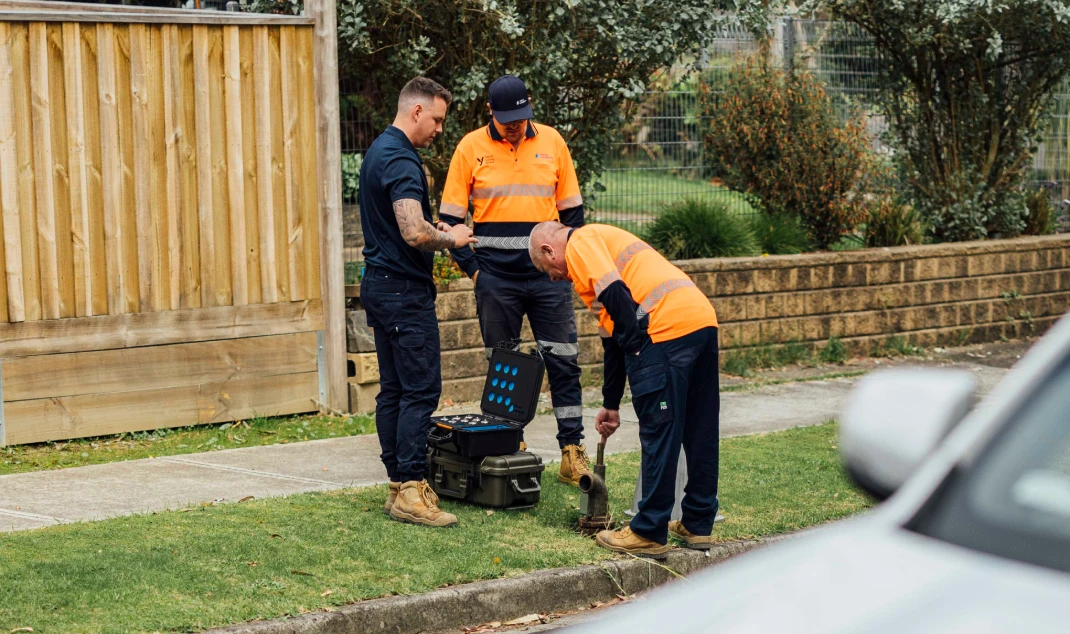
This is the method the industry was built on, and it is still how the majority of leaks in Australia and New Zealand are confirmed. A trained technician works systematically through the network, sounding every accessible fitting (valves, hydrants, meters, stop taps) with a listening stick, then using an electronic ground microphone along the line of the main where a noise is heard or where the pipe runs under unsealed ground. Suspects are pinpointed with a correlator before a mark goes on the road.
A good crew covers somewhere between 5 and 15 km of main per shift depending on fitting density, traffic and how much of the pipe is plastic. Most of the work happens at night, when the network is quiet and the roads are empty.
Where it is strong
- Every fitting gets a human ear. Nothing is filtered out by an algorithm. Experienced technicians hear things loggers miss: faint leaks on plastic services, leaks on the customer side of the meter, noise that is clearly a PRV rather than a leak.
- Works on every pipe material. Plastic mains, where noise barely travels, are where ground survey wins outright. A logger 200 m away hears nothing; a technician on the meter hears it clearly.
- No equipment to buy, own or maintain. For a council doing one sweep a year, there is no capital outlay, no batteries, no SIM cards, no software subscription.
- Pinpointing is built in. The same crew that finds the suspect confirms it and marks the dig point. There is no handover between a survey step and a follow-up step.
Where it falls down
- It is slow, and the cost scales with length. Every kilometre needs someone to walk it. On a 3,000 km metropolitan network, a full sweep is a multi-month programme.
- It is a snapshot. A leak that starts the week after the crew leaves runs until the next survey, which might be 12 or 18 months away.
- It depends entirely on the technician. Two crews with identical kit will return different find rates. The method is only as good as the people, which is a strength when they are good and a risk when they are not.
- Noisy areas defeat it. CBDs, industrial estates and arterial roads can be hard to survey even at 3 am.
Ground survey is what most people mean when they say active leak detection, and for many regional councils it remains the most cost-effective option on its own. Our Torres Strait Island Regional Council programme, 94 leaks across 12 islands, was almost entirely ground survey: no logger network could justify itself on networks that small and that remote.
Method 2: the lift-and-shift logger survey
Lift-and-shift puts the overnight listening onto hardware. A crew deploys a batch of noise loggers (typically 30 to 100 units) across an area in the afternoon, magnetically attached to valves and hydrants at roughly 100 to 300 m spacing. The loggers record the quietest sound level and its consistency during the early hours, when customer use is lowest. The next day the crew drives past to download the data, lifts the loggers, and shifts them to the next area. Fittings flagged as suspect get a technician visit with a ground microphone and correlator.
Better loggers do more than measure loudness. Correlating loggers time-stamp their recordings precisely enough that neighbouring units can be correlated against each other in the office, giving a provisional leak position before anyone has been back to site.
Where it is strong
- Coverage per shift jumps. The same two-person crew that ground-surveys 10 km can log 30 to 50 km, because the loggers listen in parallel while the crew is somewhere else.
- Consistent, objective first pass. Every fitting is measured the same way, at the quietest hour, regardless of who deployed it. Technician skill still matters at the follow-up stage, but the survey step is repeatable.
- Good on metallic and AC networks. Where noise travels well, a logger on every third fitting hears most of what is there.
- Lower cost per kilometre on large networks. For metropolitan utilities, lift-and-shift is usually the cheapest way to sweep the whole network every year.
- No permanent infrastructure. The loggers belong to the contractor or sit in the utility’s store between surveys; nothing is left in the ground to maintain.
Where it falls down
- Still a snapshot. Each area is listened to for one or two nights. A leak that starts the following week waits for the next survey.
- Plastic pipe is a weak spot. On PVC and PE mains, leak noise may not travel from the leak to the nearest fitting. Logger spacing has to be tightened, or the area ground-surveyed instead, which erodes the cost advantage.
- It generates suspects, not leaks. A logger flags a noise. Without a skilled follow-up crew, a logger survey produces a spreadsheet of unexplained readings and a lot of PRVs mistaken for leaks.
- Access and logistics. Buried or flooded chambers, fittings under parked cars, and areas with poor fitting density all leave gaps in coverage.
Lift-and-shift is the backbone of most large water utility leak detection programmes we deliver, usually alongside targeted ground survey in plastic-heavy or high-density areas. The New Zealand councils programme shows what a sustained, repeated logger-led survey does to leakage over several years.
Method 3: the permanent noise logger network
A permanent (fixed) network uses the same loggers, but they stay. Each unit is installed in a chamber with a cellular (NB-IoT or LTE-M) antenna and reports every night to a cloud platform. The software compares each fitting’s noise against its own history and its neighbours, and raises an alert when something new and persistent appears. Correlating units give a provisional position; a technician then confirms and pinpoints.
This is what the industry means by real-time leak detection, although “next-morning” is the more honest description.
Where it is strong
- Leak run time collapses. A new leak is flagged within days instead of waiting up to 18 months for the next survey. On a high-value network, the water saved by that alone can fund the system.
- Trend data, not snapshots. Months of nightly readings reveal slow-growing leaks, seasonal patterns and the difference between a leak and a noisy customer.
- It fits a smart network. Logger data sits naturally alongside DMA flow and pressure data in platforms like AquaNRW, so a night-flow rise and the acoustic alert that explains it arrive on the same screen.
- Low ongoing labour. Once installed, the network needs a technician only when it raises an alert.
Where it falls down
- Capital cost. Loggers, installation, antennas and a software subscription for every 100 to 200 m of main add up quickly. Covering a whole network is rarely economic; covering the worst DMAs usually is.
- Battery and telecom life cycle. Batteries last three to seven years depending on reporting frequency. Networks installed on 3G had to be replaced during the 3G shutdown; whatever is installed now will need the same forward planning.
- Same plastic-pipe limits as lift-and-shift. A permanent logger on a PE main is a permanent logger that hears very little.
- Alerts still need people. A fixed network that nobody follows up is an expensive source of ignored emails. The utility, or its contractor, needs a standing process for turning alerts into repairs.
- Signal and access. Deep chambers, cast iron lids and rural coverage gaps can all stop a logger reporting.
Permanent networks make the most sense where the cost of leakage is high and the pipe material carries noise well: inner-city cast iron DMAs, networks with expensive bulk water or pumping, and critical zones where a burst has a large consequence. Our IoT devices page covers the hardware side.
Side by side: ground survey vs lift-and-shift vs permanent loggers
Indicative figures for a mid-sized ANZ network with a mix of metallic, AC and plastic mains. Your numbers will move with fitting density, pipe material and local labour rates.
| Traditional ground survey | Lift-and-shift logger survey | Permanent logger network | |
|---|---|---|---|
| How leaks are found | Technician listens at every fitting and on the ground | Loggers listen overnight; technician follows up suspects | Loggers listen every night; alerts followed up as raised |
| Coverage per crew shift | 5–15 km | 30–50 km | n/a (continuous) |
| Time from leak starting to detection | Up to one survey cycle (12–18 months) | Up to one survey cycle (6–18 months) | Days |
| Cost model | Labour per km, no capital | Labour per km (lower), equipment owned by contractor or utility | Capital per logger + subscription + follow-up labour |
| Relative cost per km surveyed | Medium | Low | High up front, low per year once installed |
| Metallic and AC mains | Good | Very good | Very good |
| PVC and PE mains | Good (best option) | Poor to fair; tighter spacing needed | Poor to fair |
| Customer-side and service leaks | Good | Fair | Fair |
| Noisy urban areas | Difficult | Fair (loggers listen at quietest hour) | Good (trend data filters noise) |
| Repeatability between crews | Depends on technician | High at survey stage | High |
| In-house skill needed | High if self-delivered | Medium (follow-up and interpretation) | Medium plus alert management process |
| Ongoing maintenance | None | Minimal | Batteries, telecoms, software, chamber access |
| Best for | Small networks, plastic-heavy networks, remote areas, confirmation | Annual sweeps of large networks | High-value DMAs, critical zones, networks with expensive water |
The row that catches most people out is pipe material. A utility with 60% plastic mains that moves from ground survey to loggers on cost grounds often sees its find rate drop, then wonders why. The loggers are not faulty; the pipe is not carrying the noise to them.
How to decide: four questions and three worked examples
Answer these four questions about your network and the right method usually falls out on its own.
1. What is the pipe made of? Pull the material split from the GIS. Above about 50% plastic, loggers need tight spacing or should give way to ground survey in those areas. Below that, loggers earn their keep.
2. What is leakage actually costing? Work out real losses in ML/year and multiply by the marginal cost of water (bulk purchase, treatment, pumping). Our ILI explainer and the economic level of leakage article will get you to a defensible figure, and the Water Loss ROI Calculator turns it into a business case. High cost of water favours permanent monitoring; low cost favours an annual sweep.
3. How long can a leak run before it matters? If a leak running six months is tolerable, a survey cycle is fine. If a burst in a particular zone would close a highway, flood a basement or drop supply to a hospital, that zone wants continuous monitoring regardless of what the rest of the network gets.
4. Who is going to do the follow-up? Every method ends with a skilled technician pinpointing a leak. If that capability is not in-house, the method needs to come with it.
Example A: regional council, 350 km, 55% AC, 30% PVC, 15% cast iron, cheap groundwater supply
An annual contracted survey is the answer. Lift-and-shift across the AC and cast iron areas, ground survey through the PVC estates, delivered in two or three weeks by a visiting crew. A permanent network cannot pay back against cheap water, and the council has nobody to manage alerts. This is the typical regional council profile and it is well served by a repeatable annual programme.
Example B: metropolitan utility, 4,000 km, mostly metallic and AC in the inner suburbs, PE in the growth areas, bulk water purchased at a high price
Lift-and-shift sweeps of the whole network every 12 months, plus permanent loggers in the 10 to 15 inner DMAs with the highest night flow and the most expensive consequence of failure. Ground survey is reserved for the PE growth areas and for follow-up. Night flow from the DMAs decides which areas get surveyed first and which get a permanent network.
Example C: mine site or remote camp, 40 km, mixed materials, water trucked or desalinated
Water is extremely expensive and the network is small. A permanent logger network across the whole site is often justified, with a ground survey at commissioning to clear the backlog and establish a quiet baseline. Follow-up is handled by the contractor on a call-out basis.
The hybrid most utilities end up with
After enough survey cycles, almost every network settles on the same shape:
- A sweep of the whole network on a fixed cycle, lift-and-shift where the pipe carries noise, ground survey where it does not. The cycle is set by the economic level of leakage, usually every 12 to 18 months.
- Permanent loggers in the DMAs that misbehave, chosen by night flow and consequence of failure rather than by what the vendor can supply.
- A standing follow-up capability, in-house or contracted, that turns suspects and alerts into repairs within days rather than months.
- Night-flow monitoring sitting over the top, so the acoustic programme is pointed at the areas where the water is actually going.
The equipment is the easy part. The programme is what reduces leakage, and it needs the three methods working together rather than competing for the same budget line.
Frequently asked questions
Are noise loggers more accurate than a ground survey?
Neither is more accurate; they do different jobs. Loggers are better at consistently screening a large metallic or AC network. A technician with a ground microphone is better on plastic pipe, service connections and in confirming the exact dig point. Every logger programme still ends with a technician.
How far apart should noise loggers be spaced?
Typically 100 to 300 m on metallic and AC mains, tighter on plastic, and generally one logger per fitting in dense older networks. Spacing is set by how far leak noise travels in that pipe, not by a fixed rule.
Can a utility buy loggers and run its own lift-and-shift surveys?
Yes, and some do it well. The common failure is buying the hardware without the follow-up capability, so suspects pile up unconfirmed. If the in-house team is small, a contracted survey that includes pinpointing usually finds more leaks per dollar.
How often should a network be surveyed?
Most ANZ utilities settle on every 12 to 18 months for the whole network, with high-loss DMAs surveyed more often or monitored permanently. The right interval is the one where the cost of another survey equals the value of the water it would save.
Do permanent loggers replace DMA night-flow monitoring?
No. Night flow tells you how much water is being lost in an area; loggers tell you where. The two together are far more useful than either on its own.
What about satellite leak detection?
Satellite and other remote-sensing methods can help prioritise which areas to survey first, but they do not locate leaks to a dig point. Every satellite-flagged area still needs one of the three acoustic methods above to find the leak.
Choose the method the network needs, not the one on the brochure
Ground survey, lift-and-shift and permanent loggers are all proven. The mistake is treating the choice as a technology decision when it is really a question about pipe material, the value of water and how quickly a leak needs to be found. Answer those honestly and the method, or more likely the combination, is clear.
If you are planning next year’s leak detection budget, reviewing a logger proposal, or trying to understand why last year’s find rate was lower than expected, talk to our team. We deliver all three methods across Australia and New Zealand and will tell you which fits your network before we quote.
Read more about our active leak detection and acoustic leak detection services.